Avarages is a single number that represents the middle value of all the numbers in a list or set. There are 3 different types of average. These are called the mean, the median and the mode. Each one gives slightly different information.
Mean
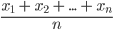
The mean is a type of average. It is the total sum of all values in a set of data, such as numbers or measurements, divided by the number of values on the list. To find the mean, add up all the values in the set. Then divide the sum by how many values there are.
Let x1, x2, … , xn be a list. Then, mean is:
Median
The median is the middle value in a set of data, such as numbers or measurements. To find the median, first put all the values in order, starting with the lowest and ending with the highest. Then look for the one that is in the middle.
Mode
The mode is the value that appears most often in a set of data, such as numbers or measurements. To find the mode, first putt all the values in order, starting with the lowest and ending with the highest. Then look for the one that appears the most times.
Harmonic mean
The harmonic mean is found by dividing the numbers of values by the sum of the reciprocals of all values. Thus, the harmonic mean is the reciprocal of the arithmetic mean of the reciprocals.
Let n be the number of values or how many numbers there are, Harmonic mean is:

Notice that x represents a set of numbers such as {x1,x2, …, xn }
For example, the harmonic mean of 1, 4, and 4 is:

The harmonic mean is best used for fractions such as rates or multiples.
Quadratic mean
The quadratic mean is found by squaring each value, adding the results, dividing by the numbers of values, and then taking the square root of that result.
Quadratic mean is:

Notice again that x represents a set of numbers such as {x1,x2, …, xn }

Geometric mean
the geometric mean is a mean or average, which indicates the central tendency or typical value of a set of numbers by using the product of their values
Given n values that are positive, the geometric mean is the nth root of their product.
for a set of numbers x1, x2, …, xn, the geometric mean is defined as:
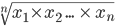
The geometric mean must be used when working with percentages, which are derived from values, while the standard arithmetic mean works with the values themselves.
Weighted mean
The weighted arithmetic mean is similar to an ordinary arithmetic mean (the most common type of avarage), except that instead of each of the data points contributing equally to the final average, some data points contribute more than others. The notion of weighted mean plays a role in descriptive statistics and also occurs in a more general form in several other areas of mathematics.
The weighted mean is found by adding the product of each weight and each value and then dividing by the sum of all weight.Let w represents each weight and let x represent each value.
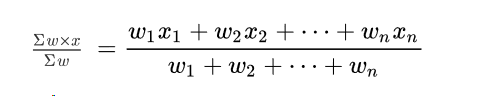
The weighted harmonic mean is used in finance to average multiples like the price-earnings ratio because it gives equal weight to each data point. Using a weighted arithmetic mean to average these ratios would give greater weight to high data points than low data points because price-earnings ratios aren’t price-normalized while the earnings are equalized.

